Description
Electrically Heated Instrument Tubing with Self-Regulating HTSX Heat Tracing
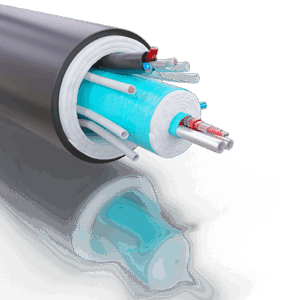
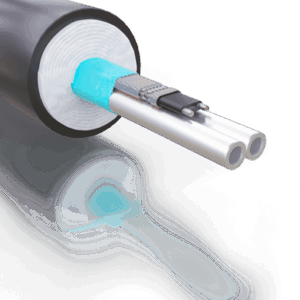
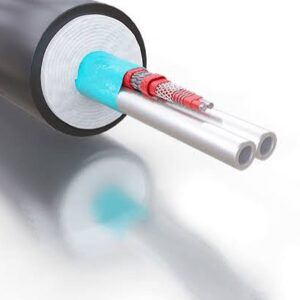
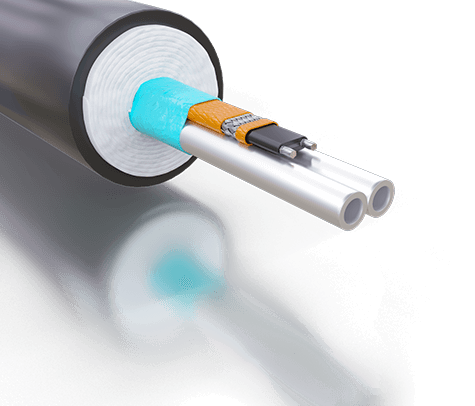
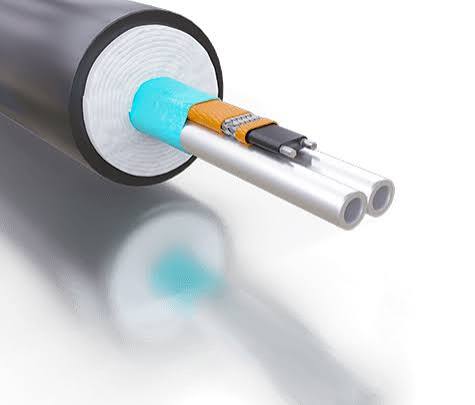
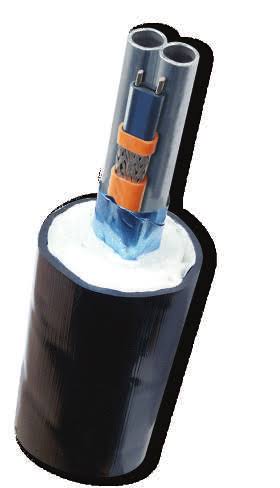
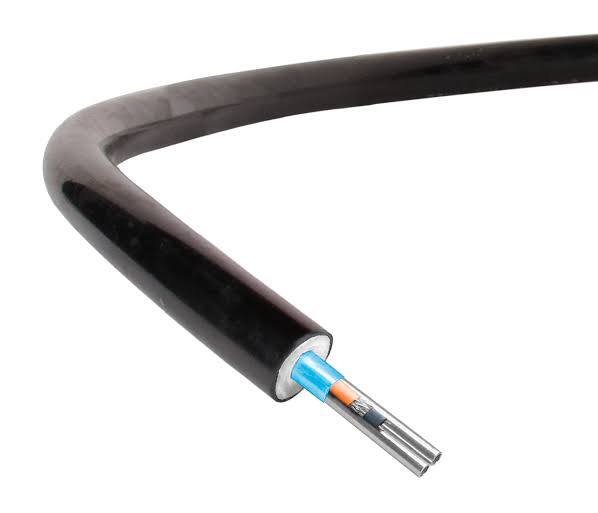
Thermon TubeTrace® with HTSX™ is a pre-engineered electrically heated tubing bundle designed for freeze protection and temperature maintenance of process and instrument tubing. The system combines process tube(s), HTSX self-regulating heat tracing, heat-reflective tape, non-hygroscopic glass-fiber insulation and a protective polymer outer jacket into one integrated assembly.
The HTSX heating cable is cut-to-length and automatically varies its heat output in response to surrounding conditions along the circuit. This helps reduce the risk of overheating the tube or product while also reducing installation waste.
Key Features
- HTSX™ self-regulating heat tracing
- Cut-to-length heating cable
- Freeze protection and temperature maintenance
- Tube temperature range from 5°C to 150°C (40°F to 302°F)
- HTSX maximum exposure temperature of 250°C (482°F)
- Lower risk of overheating the tube or process product
- Available for ordinary and hazardous areas
- Single-tube and multiple-tube configurations
- Multiple process-tube materials
- ATP or TPU outer-jacket options
- Multiple watt-density configurations
- Available with different supply voltages
- Suitable for industrial instrument and process tubing applications.
What Is TubeTrace with HTSX?
TubeTrace with HTSX is an integrated heated tubing system manufactured as a complete bundle.
The basic construction consists of:
Process Tube(s)
↓
HTSX Self-Regulating Heat Tracing
↓
Heat-Reflective Tape
↓
Non-Hygroscopic Glass-Fiber Insulation
↓
Polymer Outer Jacket
This construction is designed to provide thermal protection while simplifying installation compared with installing bare tubing, heat tracing and insulation separately.
HTSX Self-Regulating Heat Tracing
The key component of the TubeTrace system is the HTSX self-regulating heating cable.
Unlike a simple constant-output heating system, HTSX changes its heat output in response to surrounding temperature conditions along the circuit.
Thermon identifies several advantages:
- Heat output varies according to surrounding conditions.
- Lower risk of overheating the tube or product.
- Cut-to-length construction simplifies end connections.
- Reduced installation waste.
- Suitable for ordinary and hazardous areas.
This makes HTSX particularly useful where ambient temperatures can vary along the tubing route.
Temperature Maintenance
Thermon specifies TubeTrace with HTSX for freeze protection or temperature maintenance from 5°C to 150°C.
The HTSX cable can withstand temperature exposure up to 250°C (482°F).
It is important to distinguish between the normal tube-temperature range and the maximum exposure temperature of the heating cable.
| Parameter | Value |
|---|---|
| Tube temperature range | 5–150°C |
| Maximum HTSX exposure | 250°C |
| Continuous power-off exposure | 205°C |
Thermon notes that if the bundle jacket must remain below 60°C (140°F) at a 27°C ambient temperature, the tube temperature should remain below approximately 205°C (400°F) for the referenced design. Alternative designs are available for higher ambient or tube temperatures.
Freeze Protection
One of the primary applications of TubeTrace with HTSX is protecting tubing from freezing.
Outdoor instrument and process tubing can be exposed to low ambient temperatures. Without adequate heat tracing, water or other process fluids can freeze inside the tubing.
Freezing can lead to:
- Blocked instrument lines
- Incorrect instrument readings
- Process interruption
- Damage to tubing or components
- Increased maintenance requirements
TubeTrace with HTSX supplies controlled electrical heat to compensate for heat loss and maintain the required tube temperature.
Instrument and Process Tubing
The TubeTrace system is designed for electrically heated instrument tubing and can accommodate either a single process tube or multiple tubes.
Thermon identifies:
- SE – Single Tube
- ME – Multiple Tubes
Multiple-tube configurations are useful when several instrument or process lines need to follow the same route.
Process Tube Materials
A wide range of process-tube materials can be specified.
According to Thermon’s product specification, available materials include:
- 316 stainless steel welded
- 316 stainless steel seamless
- 304 stainless steel welded
- 304 stainless steel seamless
- Copper
- PFA Teflon
- Monel
- Titanium
- Alloy C276
- Alloy 825
- Alloy 20
- FEP Teflon
- Nylon
- Polyethylene
- TFE Teflon
- Special materials.
The appropriate material should be selected according to the process medium, temperature, pressure and chemical compatibility requirements.
Tube Sizes
Thermon’s specification provides process-tube outside-diameter options including:
- 1/8 in.
- 1/4 in.
- 3/8 in.
- 1/2 in.
- 5/8 in.
- 3/4 in.
- 1 in. for selected configurations.
Metric tube configurations are also available within the broader TubeTrace product family.
Available Watt Densities
The HTSX system is available in several watt-density configurations.
Thermon specifies:
- 10 W/m
- 20 W/m
- 30 W/m
- 39 W/m
- 49 W/m
- 66 W/m
at the reference temperature of 10°C.
These correspond approximately to:
- 3 W/ft
- 6 W/ft
- 9 W/ft
- 12 W/ft
- 15 W/ft
- 20 W/ft.
The required watt density should be determined from the required maintenance temperature, ambient conditions, tube size, insulation and installation conditions.
Supply Voltage
TubeTrace with HTSX is available for:
110–120 VAC
or
208–277 VAC.
Thermon’s specification provides different HTSX configurations for 120 V and 240 V systems, including 3, 6, 9, 12, 15 and 20 W/ft options.
Cut-to-Length Design
A major advantage of HTSX is its cut-to-length capability.
This makes it easier to manufacture and install tubing bundles to the actual required circuit length.
Benefits include:
- Less heating-cable waste
- Easier end connections
- More flexible installation
- Simplified field termination
- Lower installation cost
Thermon specifically identifies reduced installation cost and minimal waste as benefits of the cut-to-length HTSX design.
Insulation and Outer Jacket
The TubeTrace assembly uses non-hygroscopic glass-fiber insulation around the heated tubing.
A heat-reflective tape layer is also included to improve the thermal arrangement around the process tube.
The outer jacket is available in:
- ATP
- TPU
Thermon notes that black ATP is standard, while other jacket materials are available.
Hazardous Area Applications
TubeTrace with HTSX is designed for both ordinary and hazardous/classified areas.
The Thermon specification identifies FM approvals including:
- Class I, Division 2, Groups B, C and D
- Class II, Division 2, Groups F and G
- Class III, Divisions 1 and 2
- Class I, Zones 1 and 2, AEx e II.
CSA approvals listed by Thermon include:
- Class I, Divisions 1 and 2, Groups A, B, C and D
- Class II, Divisions 1 and 2, Groups E, F and G
- Ex eb IIC
- Ex tb IIIC.
The actual certification depends on the complete TubeTrace configuration and selected connection/termination components.
Typical Applications
Thermon TubeTrace with HTSX can be used in applications including:
Instrument Tubing
For maintaining temperature and protecting instrument lines from freezing.
Process Sampling
For maintaining process sample lines at the required temperature.
Analyzer Systems
For heated tubing connecting sampling points with process analyzers.
CEMS
TubeTrace systems can be used in emissions-monitoring installations where sample lines need controlled temperature.
Outdoor Instrumentation
For exposed tubing installed in cold environments.
Chemical and Process Plants
For instrument and process tubing requiring freeze protection or temperature maintenance.
TubeTrace with HTSX Construction
| Component | Function |
|---|---|
| Process Tube(s) | Transport process fluid or instrument medium |
| HTSX Heat Tracing | Provides electrical heating |
| Heat-Reflective Tape | Supports heat distribution |
| Glass-Fiber Insulation | Reduces heat loss |
| ATP / TPU Outer Jacket | Environmental and mechanical protection |
Thermon identifies these five components as the basic construction of the TubeTrace HTSX assembly.
TubeTrace with HTSX vs. TubeTrace with HPT
Since you are also adding TubeTrace with HPT to your website, the key difference is the type of heat tracing.
| Feature | TubeTrace with HTSX | TubeTrace with HPT |
|---|---|---|
| Heat-tracing technology | Self-regulating | Power-limiting |
| Cut-to-length | Yes | Yes |
| Tube temperature | 5–150°C | Application dependent |
| HT cable exposure | 250°C | Higher-temperature capability depending on configuration |
| Heat output | Changes with surrounding conditions | Power-limiting characteristic |
| Main benefit | Flexible temperature maintenance | High-temperature / power-limiting applications |
| Hazardous areas | Available | Available |
For TubeTrace with HTSX, Thermon specifically states that the heating output varies in response to surrounding conditions and provides a lower risk of overheating the tube or product.
Technical Specifications
| Attribute | Specification |
|---|---|
| Brand | Thermon |
| Product Family | TubeTrace® |
| Model | TubeTrace with HTSX™ |
| Product Type | Electrically Heated Instrument Tubing |
| Heat Tracing | HTSX Self-Regulating |
| Bundle Type | SE / ME |
| Tube Temperature | 5–150°C |
| Maximum Exposure | 250°C |
| Supply Voltage | 110–120 / 208–277 VAC |
| Watt Density | 10 / 20 / 30 / 39 / 49 / 66 W/m |
| Tube Materials | SS / Copper / PFA / Monel / Titanium / Alloys / Plastics |
| Tube OD | 1/8″–1″ depending on configuration |
| Insulation | Non-Hygroscopic Glass Fiber |
| Heat Reflective Layer | Yes |
| Outer Jacket | ATP / TPU |
| Cut-to-Length | Yes |
| Hazardous Area | Available |
| Applications | Freeze Protection / Temperature Maintenance / Instrument Tubing / Process Sampling |
Specifications are based on Thermon’s current product page and HTSX product datasheet.
Why Choose Thermon TubeTrace with HTSX?
Thermon TubeTrace® with HTSX™ provides an integrated solution for applications requiring reliable freeze protection and temperature maintenance of instrument and process tubing.
Its combination of self-regulating HTSX heat tracing, cut-to-length construction, multiple tubing materials, multiple watt densities and hazardous-area approvals makes it suitable for demanding industrial installations.
The system is particularly attractive when the tubing route is exposed to changing ambient conditions and the project requires a factory-assembled heated tubing bundle rather than separate field-installed components.